
Blog · September 19, 2026
How to Price Christmas Light Installation
How do home service professionals price holiday and Christmas light installation? Everything you need to know before pricing your next installation job.
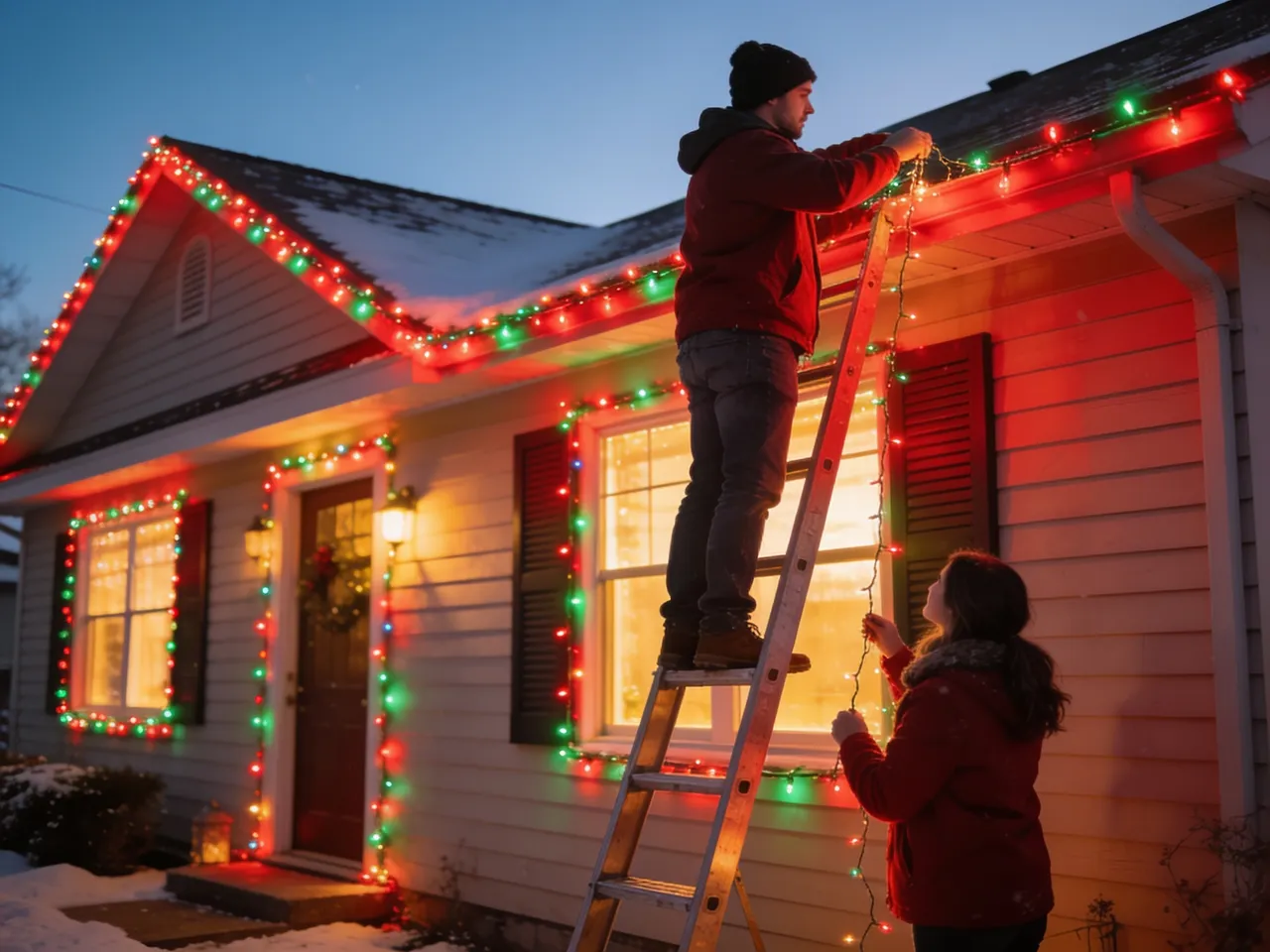
If you are starting a Christmas light installation business, one of the first questions you will run into is deceptively simple: how much should you charge?
There is no single price that works for every house. A straightforward ranch-style home with a single roofline might take a couple of hours, while a large two-storey house with multiple roof peaks, trees, windows and a long driveway can turn into an all-day project. The materials can be different too. Some customers want a basic roofline with warm white lights, while others want a much more elaborate display.
That is why your Christmas light installation price needs to account for the amount of lighting being installed, the time involved, the equipment and materials required, and the difficulty of the property.
For most installers, pricing by the linear foot is a useful starting point because it gives the customer a relatively simple way to understand the quote while giving the business a consistent way to estimate jobs.
How much does Christmas light installation cost?
Professional Christmas light installation commonly costs homeowners somewhere around $2.50 to $7 per linear foot, depending on the type of installation and what is included. That range can move considerably higher for difficult installations, specialty lighting or more elaborate displays.
For example, a home with 150 feet of roofline might produce a quote somewhere around $375 to $1,050 for the installation itself. That does not necessarily mean the customer is buying 150 feet of lights from you. Some companies supply the lights and other materials as part of the service, while others install customer-provided lights.
The distinction matters when you are setting your prices. A $4-per-foot installation price may sound straightforward until you realize that the customer expects you to provide commercial-grade lights, clips, extension cords, timers and replacement bulbs. Your quote needs to reflect the entire job rather than just the time your installer spends on the roof.
There is also a significant difference between installing lights on a single-storey home and working on a steep roof with multiple levels. A linear-foot price gives you a starting point, but it should not prevent you from adjusting the quote when the property requires considerably more labour or equipment.
Should you charge by the linear foot?
For most residential Christmas light jobs, pricing by the linear foot is one of the easiest methods to use.
The basic calculation is simple: measure the areas that will receive lights and multiply the total footage by your price per foot. If you charge $4 per linear foot and the installation requires 200 feet of lighting, the starting price would be $800.
The advantage is that you can give customers a quote that makes sense without having to explain every individual labour calculation. It also makes estimating faster when you have several similar properties to price.
The problem is that not every foot of lighting takes the same amount of time to install.
A 100-foot straight roofline that is easily accessible from a ladder is a very different job from 100 feet spread across several roof sections, dormers and peaks. If you rely entirely on a per-foot price, you can end up undercharging for properties that look small on paper but take much longer to complete.
A good pricing system therefore uses the linear-foot calculation as a foundation and adjusts from there.
What should you include in your Christmas light installation price?
Before deciding what you charge per foot, decide exactly what the customer is getting.
Some Christmas light companies provide everything. They supply the lights, install them, take them down after the holidays and store them until the following year. Others charge separately for installation and removal, with the customer purchasing or supplying the lights.
Those are very different businesses from a pricing perspective.
If you are providing the lights, your quote needs to recover the cost of the lights as well as clips, extension cords, timers, replacement bulbs and other materials. You also need to account for the fact that commercial-grade lighting can potentially be reused for several seasons, which means you may be able to spread that material cost across multiple years of installations.
Removal is another cost that is easy to overlook. Installing lights might take three hours, but someone still has to return after Christmas, remove everything safely and either return the equipment to the customer or bring it back for storage.
If you include removal in your original price, make that clear. Customers are much less likely to question the price when they understand that they are paying for an entire seasonal service rather than someone simply coming out for a few hours in November.
How much should you charge for labour?
Labour is usually the biggest variable in a Christmas light installation business.
A useful way to price a job is to estimate how many hours it will take and make sure the resulting price produces the hourly revenue you need. If you know that you need to generate $100 per crew hour to cover labour, overhead and profit, a four-hour installation needs to produce roughly $400 before considering additional material costs.
That does not mean you necessarily want to tell the customer you charge $100 per hour. In many cases, customers are more comfortable receiving a project price than watching an hourly meter run.
The hourly calculation is primarily for you.
If you estimate a job at $600 and expect two installers to spend four hours completing it, you have eight labour hours involved. That works out to $75 in revenue per labour hour before accounting for materials and other costs. If the same property requires eight hours because of difficult access, the economics look very different.
This is why experienced installers become better at pricing over time. After completing enough jobs, you start to recognize which properties are going to consume a disproportionate amount of time.
Don’t forget the roof and property
The physical characteristics of the property should have a major influence on the quote.
Height is an obvious factor. A single-storey home may be relatively straightforward, while a two- or three-storey installation can require extension ladders, specialized equipment or additional safety precautions. Steep roofs can also slow down installation considerably.
Then there are trees, columns, windows, fences and other features. Wrapping a tree can take much longer than running a straight line along a roof edge. Installing lights around a series of windows can require repeated ladder movements and more clips. Large shrubs or hedges may require a completely different installation approach.
Accessibility matters too. If installers can park directly beside the house and work their way around the property, the job will usually be faster than one where equipment has to be carried a long distance.
These details are easy to miss when pricing from a photograph, which is why it can be useful to ask customers for several photos or conduct an in-person estimate for larger installations.
Set a minimum installation price
A minimum charge can protect you from small jobs that are technically profitable on a per-foot basis but aren’t worth the trip.
Imagine someone wants 30 feet of lights installed above a front door. At $4 per foot, the installation would generate only $120. You might still have to drive to the property, unload equipment, speak with the customer, set up a ladder, complete the installation and clean up afterward.
The amount of lighting has little relationship to the amount of administrative and travel time involved.
A minimum installation charge solves this problem. It gives you a floor below which you simply do not take a job unless there is another reason for doing it.
The exact minimum depends on your market and operating costs, but the principle is important: don’t let a simple per-foot formula force you into taking small jobs that don’t make economic sense.
How should you price Christmas light removal?
Removal is often priced as part of the seasonal package, but it can also be charged separately.
If you charge separately, the removal price should reflect the same factors that affect installation. A large, complicated display will take longer to remove than a simple roofline, and difficult access can make removal almost as time-consuming as installation.
Some businesses offer an installation-and-removal package because it is easier for the customer to understand. Instead of receiving one bill in November and another in January, the customer knows the total seasonal cost from the beginning.
This can also make your business more attractive to customers who don’t want to think about what happens after the holidays. You install everything, take it down when the season is over and leave the customer with nothing else to organize.
What about Christmas light storage?
Storage can become another source of revenue if you provide and remove the lights yourself.
The attraction is convenience. A customer who has several hundred feet of lights, extension cords and installation hardware may not have anywhere convenient to store it. If you are already removing the display, keeping the materials until the following season can be a relatively easy additional service.
Storage also gives you another reason to maintain the customer relationship beyond the initial installation.
Instead of treating every November as a new sales cycle, you can have customers returning year after year. Their property measurements are already known, you know what type of display they prefer and you already have the materials from the previous season.
That recurring relationship can be considerably more valuable than constantly trying to replace customers who only purchase a one-time installation.
How to give a Christmas light installation quote
The easiest way to avoid pricing mistakes is to collect enough information before giving the customer a number.
For a straightforward home, photographs may be enough to estimate the approximate amount of lighting required. For more complicated properties, an in-person estimate gives you the opportunity to measure the roofline, identify difficult areas and determine what equipment will be needed.
Ask what the customer actually wants illuminated. Some homeowners only want the front roofline, while others want windows, trees, columns, railings and other features included. It is much easier to produce an accurate quote when the scope is defined before the price is presented.
Your quote should also make clear whether lights are supplied, whether installation and removal are included, whether storage is available and what happens if lights fail during the season.
A customer should be able to look at the quote and understand what they are paying for without having to call you for an explanation.
How to increase your Christmas light installation prices
If you are consistently booking jobs but finding that crews are working longer than expected, your prices may simply be too low.
Before raising your per-foot rate across the board, look at which types of jobs are causing the problem. If two-storey homes consistently take longer than expected, you may need a height surcharge. If tree wrapping is labour intensive, price it separately instead of trying to absorb the work into your standard roofline rate.
You can also charge more for installations that require specialized equipment or additional crew members.
The goal is a pricing system that reflects the actual work involved while remaining simple enough that you can quote jobs quickly.
A simple Christmas light pricing formula
A practical starting point is: Estimated linear feet × price per foot + special installation charges + materials or equipment = total price
From there, compare the quote against your expected labour hours.
If you estimate 250 linear feet at $4 per foot, your starting price is $1,000. If the property requires another $150 in specialized materials and you expect the installation to take six labour hours, you can evaluate whether the resulting $1,150 price gives you enough room for labour, overhead and profit.
The formula gives you a consistent starting point so you aren’t inventing a price from scratch every time someone asks for a quote. You still adjust it with your own judgment.
Making Christmas light installation easier to sell
Pricing is only half of the problem. Once you know what you charge, customers still have to contact you, explain what they want, wait for a quote and find a date that works.
That can create a lot of unnecessary back-and-forth during the busiest part of the year.
A landscaping or property-service company can make the process much simpler by putting its Christmas light service directly on its website. Customers can select the type of service they want, provide information about their property, see a price and choose an available date without starting with a phone call.
For a seasonal business, that can be particularly useful because November and December are often already busy. The more of the quoting and scheduling process a customer can complete on their own, the less time the owner or office staff has to spend answering basic pricing questions.
Online booking doesn’t require replacing the software the business already uses. A system such as Sorvius can sit in front of existing scheduling and invoicing software, handling the part of the process that happens before a job has actually been created.
Final thoughts on Christmas light installation cost
There is no magic number for Christmas light installation. A useful price has to work for the customer and for the business doing the work.
Start with a per-foot rate if that makes estimating easier, but don’t let it become a substitute for understanding the property. Height, access, roof complexity, trees, materials and removal can all turn a seemingly simple installation into a much larger job.
Most importantly, keep track of how long your installations actually take. After a season or two, your own job history will tell you far more about what you should charge than a generic pricing guide ever could.
The businesses that make the most of Christmas lighting know what each job costs them, quote consistently, and make it easy for customers to say yes.
Common questions about holiday light installation pricing
How much does professional Christmas light installation cost?
Professional Christmas light installation commonly costs around $2.50 to $7 per linear foot, although the actual price depends on the property and what is included in the service. A simple single-storey roofline will generally cost less than a large home with multiple roof sections, trees, windows and difficult access. The quote may also include the lights themselves, installation, removal, storage and maintenance, so check what is included before comparing prices between companies.
How much should I charge per foot for Christmas light installation?
A price of roughly $2.50 to $7 per linear foot can be used as a starting point for residential Christmas light installation, but your actual rate should be based on your labour costs, materials, overhead and the type of properties you service. A straight, accessible roofline may be profitable at one rate, while a complicated two-storey installation could require a higher price because it takes considerably longer to complete. Tracking your actual labour time on previous jobs is one of the best ways to determine whether your per-foot rate is working.
Should Christmas light installers charge by the hour or by the foot?
Many installers use a per-foot price when quoting residential jobs because it gives customers a simple project price and makes estimates relatively quick. Behind the scenes, however, it is still important to calculate the expected labour hours. Two properties with the same amount of lighting can require very different amounts of work, so relying exclusively on linear footage can result in underpriced jobs. Using the per-foot calculation as a starting point and adjusting for property complexity is often more practical than choosing between hourly and per-foot pricing.
Should I charge separately for Christmas light removal?
You can either include removal in the original seasonal price or charge for it separately. Including removal can make the service easier for customers to understand because they know the total cost of the season upfront. If you charge separately, make sure the customer knows this when they accept the installation quote. Removal can take a significant amount of time on larger or more complicated displays, so treating it as free work can quickly reduce your profit.
Do Christmas light installation companies charge for the lights?
It depends on the business model. Some companies provide the lights and installation as part of a complete seasonal package, while others charge separately for the lighting or install lights supplied by the customer. If you provide the lights yourself, your pricing needs to account for the initial material cost as well as clips, extension cords, timers and replacement materials. If the lights can be reused for several seasons, the cost can potentially be spread across multiple installations rather than recovered from one customer in a single season.
How do I price a difficult Christmas light installation?
A difficult installation should not necessarily be priced using the same per-foot rate as an easy roofline. Consider the height of the building, roof pitch, number of roof sections, trees or other features being decorated, accessibility and whether specialized equipment or additional workers are required. A property that takes twice as long to install should not be priced the same simply because it has the same number of linear feet. Adding specific charges for difficult areas can help keep your pricing consistent without dramatically increasing your standard rate for every customer.
What should be included in a Christmas light installation quote?
A professional quote should clearly explain what areas of the property will be decorated and what the customer is paying for. Depending on the service, this might include the lights, installation, clips and other materials, removal after the holidays, storage and maintenance during the season. It should also identify anything that costs extra, such as tree wrapping, additional roof sections, specialized equipment or repairs. The clearer the scope is before the work begins, the less likely you are to have disagreements with the customer about the final price.
Booking winter work before it arrives
Customers start looking for winter services in September, so seasonal prices need to be posted before then. Sorvius lets you list each winter service at your own price, such as snow plowing by driveway size, gutter cleaning, or light installation, so customers can see the cost, pick a date, and save a card on file from your website or a link you send them. See pricing or try the demo.